
In today’s data-driven world, having access to the most relevant informationi s crucial for effective and efficient product development. Getting the right information at the right time at the right people is the winning strategy. However, this is obviously much easier said than done in practice with many hurdles arising. So where do you start on this improvement journey?
Information sources
Typically information within an organization grows organically over time. While in the beginning it seems this was easy to manage, it now has become a serious aspect to actively consider. In particular, the number of data storage locations and tools in use within the organization seems to have grown exponentially over time. Each individually seemed to make sense (at least at the time), but from a distance you are not quite sure, do we actually need all of them?
Typical questions that arise quickly when organizations take the first step in managing their data sources are:
- What types of data do we have and what new data will we need?
- Is the data also information and if not, how do we transform raw data into valuable information and subsequently actionable wisdom?
- How do people effectively interact with both vast and diverse datasets, typically fragmented over multiple locations, be it digital or sometimes still analogue?
Organizing your data landschape
To make data analysis an integral part of your way of working it is important to organize your data sources to be able to work for you instead of you having to continuously struggle with finding the right information.Is that file you were looking for on Sharepoint or was it shared in Teams chat only? Did someone upload it to the Document Management System or is the latest version still in my e-mail inbox?
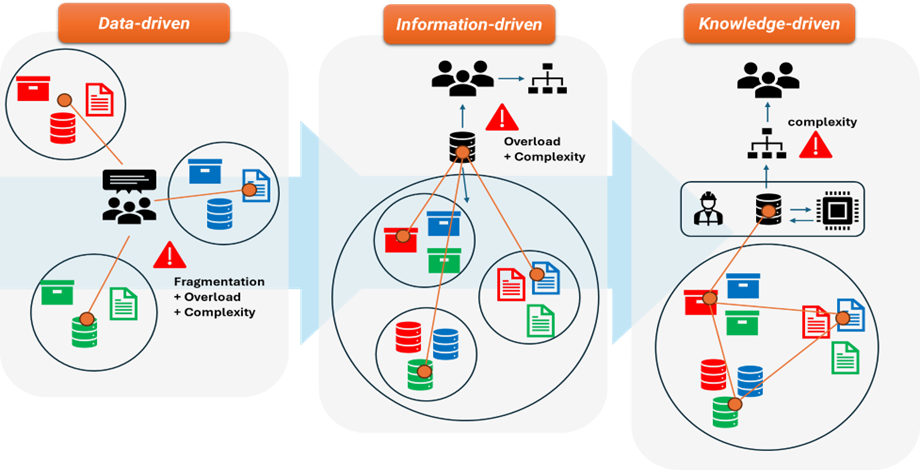
So let’s explore the journey from data to wisdom and how you can become a master of your information flow. Typically we can distinguish three specific levels of information mastery, namely
- Data-driven
- Information-driven
- Knowledge-driven
Challenge 1: From Data to Information
The first challenge is to overcome data fragmentation. Often, data is scattered across multiple systems, of different types, a variety of structures and possibly even consisting of numerous copies that are not in sync. All this fragmentation leads to inconsistencies, confusion and inefficiencies where teams extensively need to align and discuss to gain the insights they need. In this situation, the people on the work floor are fully in control and insights are typically discovered in (extensive) meetings or work sessions.
To overcome this challenge, it’s essential to bring data into a connected system ecosphere. Note that in many cases this definitely does not mean you should rely on a single digital tool to rule them all; rather, it’s about using the best tool for specific tasks but ensuring that such a tool can and is also linked and communicates with other tools (for example via API’s or cloud connectivity). By integrating (preferably a limit set of) tools it makes it easier for teams or individuals to search and retrieve all the relevant data. A good advice here is also to stop sharing actual documents, but instead share the links to documents. Many organizations have already taken this first step at various levels of integration. This has been made relatively easy by more sophisticated tooling (e.g. SharePoint and Document Management Systems). However, many of the challenges still remain that originate from the variety of different data types and formats that you want to connect. Already here Artificial Intelligence agents can play a significant role (more on that later). The main aim for this first step is to make sure all the data is harmonized before it is presented to users
Challenge 2: From Information to Wisdom
Once all your data is consolidated and easily searchable, the next challenge pops up. Each search request will likely result in large amounts of related information, of which most is probably not at all that relevant. In fact, it may even become harder to find the actual valuable information hiding amidst the results, thus leading to a clouded judgement (or as a Dutch proverb goes “door de bomen het bos niet meer zien”).
Most organizations are likely in this stage, expecting that the first step of digitizing all their relevant data would somehow miraculously enable their users (experts, developers, etc) to gain all the insights they need.
The rise of Artificial Intelligence is promising to assist in managing this data overload, but the reality is that at this stage the added expertise of skilled domain specialists remains indispensable. These experts rely on their knowledge and expertise to filter & interpret data, identify patterns, and derive new insights that drive innovation. Bringing together the skillset of domain experts and advanced AI-tooling therefore provides the foundation of knowledge capture to manage complexity.
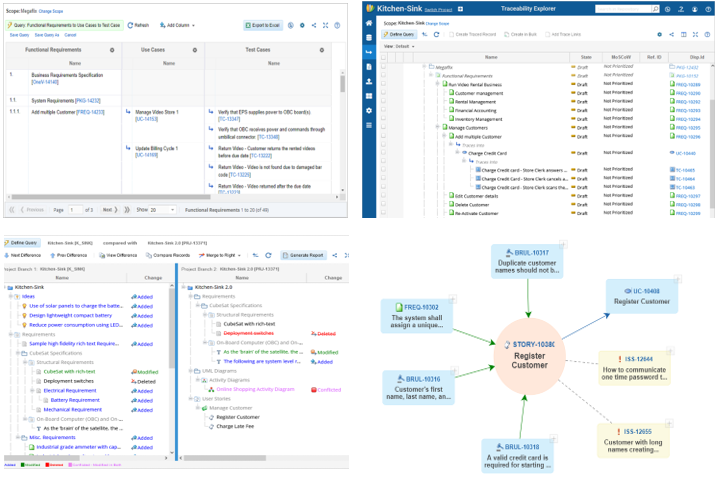
Challenge 3: Bringing Data to Life with TopTeam Requirements (visual wisdom)
Once you have put in place a reliable data management system and an organization capable of processing the information, you will be optimally placed to start extracting valuable insights from all your data assets. Such tooling will always be context dependent, but you could think of the following examples:
- Create Automatic Dashboards: Visualize and track data in a way that highlights key metrics and trends
- Advanced Search Capabilities: Search information throughout your organization via a single user interface
- Develop Powerful Visuals: Use compelling data visualizations to communicate complex concepts effectively.
- Explore Interconnectivity: Leverage insights from the interconnected data to uncover new opportunities and optimize systems.
Data Insight
In conclusion, becoming a master in handling your information flow is not just about managing data; it’s about transforming it into wisdom that in the end will drive product development excellence. By integrating (digital) tools, leveraging AI, and applying vital domain expertise, you can turn your data into a powerful asset.
More information
Do you want to learn how to gain insights on your development knowledge options? And how tools like TopTeam Requirements or Targetprocess can enable a competitive edge in your product development? Contact us via info@synergio.nl.
